Most people who walk through the door know what they came for, a float, a sauna, a quiet hour. Fewer know why the studio exists in the first place, or why it looks the way it does. This is that story.
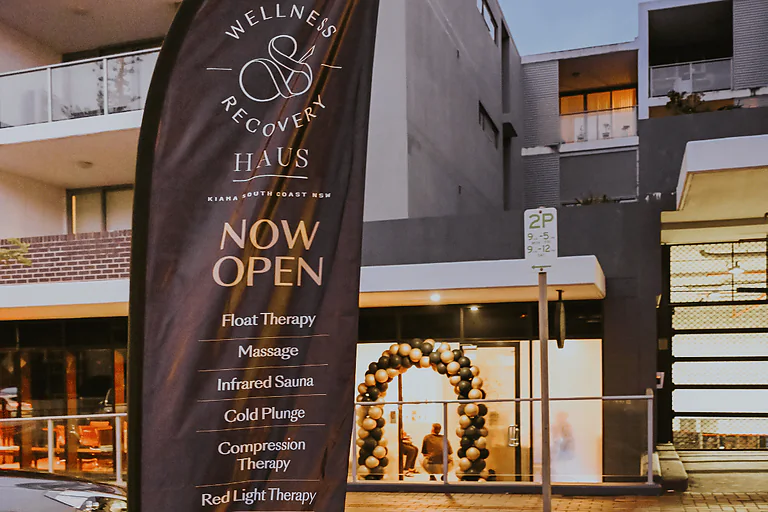
Wellness & Recovery Haus was built around a straightforward observation: the South Coast had plenty of gyms and plenty of day spas, but very little that sat between the two, a genuine recovery studio, private and considered, rather than a group class or a beauty treatment. Luke and Jordan were aiming to bring an elevated experience of wellbeing to the South Coast, on a premise the brand still leads with today: wellness should feel accessible, supportive, and consistent, not another decision to make each week.
The private-suite model was a deliberate choice. There are no crowded communal spaces, screens, or unnecessary distractions. Every session is provided in its own suite, which changes the character of a visit more than it might sound. On arrival, phones go on silent, and guests are encouraged to turn up as they are, without needing to prepare a version of themselves.
Kiama itself was underserved. The closest comparable studios cluster around Wollongong, Dapto, and Shellharbour, leaving Kiama and the surrounding towns, Gerringong, Jamberoo, and the wider South Coast without a local option built around this range of recovery-focused modalities. Starting here was part of the same thinking: accessible should mean nearby.
It is easy to assume a recovery studio is mostly for people in active training, or for visitors passing through on a long weekend. In practice, most guests are locals managing the ordinary accumulated load of everyday life: tradespeople finishing a physical week, parents who have not had a quiet hour in months, shift workers whose sleep is out of step with everyone else's, people commuting to Wollongong or further and arriving home with nothing left. Recovery has a place in an ordinary week, not just a special occasion, and that is who the studio was built for as much as anyone training for performance.
The easiest way recovery fails as something worth doing is when it is treated as an occasional indulgence rather than a standing part of a week. A single float session feels good. A weekly one starts to change how a week feels overall. This is why the studio's pricing is structured around ongoing access rather than only one-off bookings, current membership options cover float therapy, infrared sauna, cold plunge, oxygen and hydrogen therapy, and compression therapy individually, each with its own weekly or monthly rate on the pricelist, so a regular routine can be built around whichever modality actually gets used, rather than paying for access to everything at once.
For someone who is not ready to commit to a routine, a single session or a gift card works just as well as a first step. For someone building a weekly habit around work, training, or simply the accumulated load of ordinary life, the ongoing pricing is designed to make that easier to sustain than re-deciding whether it is worth it each time.
Spring on the South Coast has its own rhythm. The days lengthen, and for a lot of people it is the point in the year where the accumulated fatigue of winter becomes harder to ignore. It is a natural moment to start a routine rather than wait for summer and expect to feel different by default, since a weekly float or sauna session slotted into spring tends to be easier to sustain than one started cold in the middle of a heatwave or a winter cold snap.
No. Single sessions and gift cards are available to anyone. Ongoing modality memberships are for guests who want to build a specific modality into a regular routine.
No. The studio sees far more people managing everyday demands, work, sleep, stress, than competitive athletes, and it was built with that broader group in mind.
It was a deliberate design choice from Luke and Jordan, to remove the distraction and self-consciousness of a shared space and let guests properly switch off during a session.
See our first-timer's guide for a full walkthrough of what to expect and how to prepare.
No. The studio serves the greater Illawarra region, including Kiama, Gerringong, Jamberoo, Shellharbour, and Wollongong.
Book online or visit Wellness & Recovery Haus, Shop 8/65 Manning St, Kiama NSW 2533, at wellnessrecoveryhaus.floathelm.com/booking.