The cold plunge has become the most talked-about modality in recovery, and also the most exaggerated. Some of the claims attached to it hold up. Others do not. This is a plain look at what a cold plunge actually does, on its own, without folding it into a sauna cycle or a fat-loss trend.
Cold water immersion triggers an immediate, sharp physiological response. Blood vessels at the skin's surface constrict, pushing blood back toward the body's core. Breathing quickens for the first 30 to 60 seconds before settling. Norepinephrine, a hormone involved in alertness, mood and focus, rises sharply. Once you step out, the vessels dilate again, part of what is generally described as a vascular pump effect, moving blood back through the tissue.
This is the same underlying mechanism the cold phase contributes to Contrast Therapy, but on its own, a cold plunge is a shorter, more concentrated version of that same response, without the preceding heat.
A 2025 study published in Applied Sciences (Teległów, Września & Blecharz) compared 15 regular winter swimmers against 15 non-swimming controls, measuring hormone levels and mood states before and after a single cold-water immersion at 4°C. The swimmers showed a sharp reduction in noradrenaline and adrenaline immediately after immersion, alongside lower depression-dejection scores and improved mood that the researchers found persisted 24 hours later.
It is worth being precise about what this does and does not show. The study involved a small sample, 30 participants in total, all male, and the authors themselves flag the group size as a limitation requiring cautious interpretation. It is also a single-session, cross-sectional study rather than a long-term trial. What it adds to a growing body of similar small studies is a consistent signal: cold exposure appears to produce a genuine, same-day mood lift for at least some people, even if the exact mechanism and how long it lasts for a first-time or occasional plunger is still being worked out.
We would rather describe a modest, early finding honestly than round it up to more than it is. As covered in our piece on recovery myths, cold plunge's reputation for burning fat quickly outpaces what the research on brown fat activation actually supports. The mood and nervous-system effects are a separate, better-supported claim, and worth treating as such.
Sessions use the iCool Sport® Cold Plunge, a commercial chiller unit that keeps water at a precise, consistent temperature with no warm pockets. Most guests aim for two to three minutes, though even 60 to 90 seconds produces a strong physiological response. The initial cold shock response, that sharp intake of breath and urge to get out, typically passes within the first 30 to 60 seconds. Breathing through it is the skill, and most guests find it becomes easier with each visit.
Sessions run in a private suite, with the studio team on hand to talk through pacing for a first-timer.
Cold plunge suits people who train regularly and want a sharper, more concentrated recovery option than a full contrast cycle. It suits guests looking for a genuine mental reset, alertness and clarity rather than a wind-down, since the effect is stimulating rather than sedating. It is also a reasonable entry point for anyone curious about cold exposure who wants to try it in a controlled, private setting rather than an open-water swim or a home ice bath with no supervision.
It is not the right choice for someone looking purely to relax or downregulate before sleep. Float or infrared saunas tend to suit that goal better.
Cold plunge is most commonly booked as part of Contrast Therapy, alternating with the Clearlight® Infrared Sauna in a single guided sequence. It also pairs well after a remedial or sports massage, since muscles that are already warm and relaxed respond well to the cold phase. Some guests prefer it on its own, as a short, sharp addition to an existing routine rather than a full session in itself, or booked directly via the Cold Plunge service page.
Cold plunge is a low-risk, well-tolerated addition to a recovery routine for most healthy adults, but it is not a treatment for any medical condition, and the research on its longer-term effects, beyond a single session's mood lift, is still developing. Anyone with a cardiovascular condition or other health concern should check with their GP before trying cold water immersion for the first time.
The iCool Sport® Cold Plunge is kept at approximately 9°C by a commercial chiller with continuous filtration and sanitisation. Confirm the current setting with the studio team, as this can be adjusted.
Most guests aim for two to three minutes. Even 60 to 90 seconds is enough to produce a strong response, and building up gradually is completely normal.
Yes, with guidance. The team will walk first-timers through pacing and breathing before their first plunge.
Not meaningfully on its own. Cold exposure does activate a small amount of metabolic activity, but it is not a substitute for diet and overall activity when it comes to fat loss. Its better-supported benefits are around mood, alertness and recovery.
Yes. Cold plunge is available as a standalone session as well as part of Contrast Therapy.
Yes, though it remains an early and developing area with mostly small studies. The pattern across current research is consistent, a same-day mood lift and stress-hormone reduction, even though larger trials are still needed to confirm how long the effect lasts.
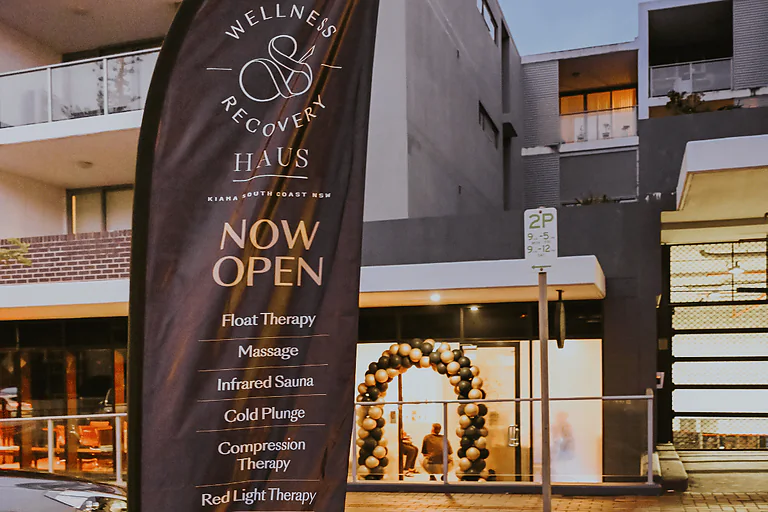
Book a cold plunge session at Wellness & Recovery Haus, Shop 8/65 Manning St, Kiama NSW 2533, at wellnessrecoveryhaus.floathelm.com/booking.